Showing posts with label Geschmack. Show all posts

Thursday, July 19, 2012

Geschmack: Das Ecksofa


Keeping on the theme of German household basics, it's time you formally met the corner sofa, or Ecksofa.  One part sofa, one part pull-out couch, one part La-z-boy and all parts Ikea, the corner sofa is made for the most uncomfortable lounging experience possible.

It works like this.  Take a double bed.  Stretch it out so it's long enough for two very small people lying down head to toe or one Croatian basketball player.  Upholster it with vinyl.  Add shiny metal legs.  Now cut away one third of the bed to make a banana shape.  Instead of wastefully throwing out this one-third, ingeniously fold it up on top of the bed to make couch cushions so that, should the owners want, the monster bed can be reconstituted in the fullness of its original glory, to the chagrin of any and all normal-sized bed linens.  Make sure the cushions are uncomfortable.  Leave a weird peninsula hanging out at the side for full body "lounging".  Behold, the Ecksofa.

Sadly, despite its apparent multi-tasking capabilities, the Ecksofa fulfills none of its promises.  There is nothing more awkward than lying down on the corner piece, unless it's trying to sleep on the fold-out sofa.  It's like having a giant-sized rubber mattress at your disposal.  Good for swingers, bad for house guests.

image via thomaskachel.de

Wednesday, June 6, 2012

Wirklich? Really?: Der Kuchenbehälter, a Cake Carrier


One thing I've learned at my work is that Germans are really into cake.  Besides the requisite 4PM "Kaffee und Kuchen" tradition about which guidebooks wax eloquent (which of course is a culturally distinct eating ritual that bears no resemblance to the English preference for 4 o'clock tea or North American celebration of anytime donut), a general interest in cake making and eating seems to take up a large part of the German female brain.  And along with this fascination with fondant, leaveners, and cake pops come the requisite accessories.  Behold, the cake carrier.

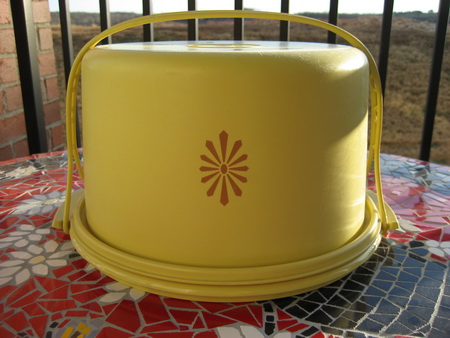
The cake carrier in Germany does not resemble the colourful retro contraption as seen above.  Nor is it's presence limited to the households of people who had a few margaritas at a garden party in 1982 and accidentally bought into a complete set of orange and green Tupperware that included a devilled egg holder.  The cake carrier of today is usually made of clear, unornamented plastic, either in the shape of a log or a circle.  The handle makes it easy to carry, although Germans must be pretty much obliged to be constantly eating cake in order to justify storing one of these things in a tiny German kitchen.

So, the question goes, which came first, the carrier or the cake?

Whatever the answer, cake is important to Germans, as is the ability to renew the cake supply.  Knowing how to bake is taken as a given at my workplace.  It is assumed that I can whip up all delicacies with vaguely Anglo-American origins, from (Philadelphia) cheese cake with graham crust to hot cross buns to (Starbucks) cake pops. For kids, cake appreciation comes complete with quizzes on the comparative qualities of yeast and sour-cream dough.  Don't think that Betty Crocker or time-saving devices have anything to do with this brand of domesticity.  One coworker was showing off a photo of the cake she is baking for her cousin's wedding - using a highly coveted German-language cookbook that she snapped up in an ebay bidding war for the bargain price of 130 Euros.

And well, okay, maybe it's expected that childcare professionals have a Martha Stewart thumb, but I can attest that even the ladies of high finance can spend a Sunday afternoon or two crafting pralines for their coworkers.  I just don't know if I can ever be thankful for breakroom donut holes ever again.

Sunday, May 20, 2012

Geschmack: Russisch Brot


When I saw these alphabet cookies in the supermarket, I was sure I had found the German answer to animal crackers.  Cute packaging, vaguely educational value, sugar content - check.  Sadly, Russisch Brot are more cracker than cookie and more tasteless than anything else.  Any questions about their mysteriously opaque Russian origins – they’re called “Russian Bread” in German for those of you without Google Translator doing your thinking for you -  are answered with your first taste, because nobody knows how to screw up chocolate like the Russians.   The only reason I can possible think that cocoa has been added (and it's there in the ingredients) is to give the cookies that dark brown edible-side-of-burnt colour, the origin of which has been gratifyingly misidentified by Chowhound snobs waxing nostalgic for Europe.

Speaking of origins, they're murky, and nobody knows who gave them the Russian name.  There are competing versions giving credit to witty Viennese and travelling Dresdners bringing a taste of the motherland to the German speaking world.  The ungrammaticalness of the name (because in German, adjectives always have special endings depending on the case and gender of the noun they describe, which "Russisch" has brazenly forgone) is yet further proof that they were brought to Germany by someone without enough German to pass a citizenship exam.  I can certainly think of a few Katarinas and Natalias who are currently evangelizing this particular brand of German grammar.  However, the cookies that I bought at my local supermarket have been otherwise thoroughly naturalized – no backwards Rs or upside-down Ls here.

Wednesday, April 11, 2012

Geschmack: Haribo Bronchiol Cough Drops


What with the recent talk about doctor's notes, you must know that I am sick here in Germany.  And, because I actually have a job, that means I had to go to a doctor and get an official note to excuse me from work.  I was given a week to recuperate, which seemed pretty generous to me, but the doctor clearly knows a thing or to about the lifespan of German viruses, because I needed it.

As a result, I have been trying many types of German cold medication - most of it herbal in nature, because here every request for medication goes through the pharmacist, and pharmacists appear to be very unwilling to give out anything that may actually have a pain-relieving effect to foreigners.  It probably doesn't help that I invariably turn up at the pharmacy with a long list of unfamiliar drug names that the pharmacist then has to look up letter by letter on her little computer, all of which always turn out to be banned or otherwise controlled here in Germany.  So I walk away with supplements, menthol rubs, and saline nasal sprays instead of anti-histamines, cough suppressants, or painkillers.  Forget non-drowsy, I dearly love anything with enough kick to make it unsafe for me to operate heavy machinery.  

To be honest, though, it probably took me longer than usual to recuperate from the flu simply because I didn't have the stimulating effects of these carefully controlled and possibly addictive drug components.  I was so cranky about not getting Tylenol Cold when and where I wanted, that maybe I am just the drug-dependent North American the pharmacist suspects I am after all.

I was wondering how it could be that people have to take one or two weeks off for colds and flus here.  Well, here is the why: they don't have Dayquil to get them up and running in two days, and they're happy to let someone have the time off because then nobody's breathing germs all over the office and the doctor and pharmacist have conspired to guarantee that the missing coworker is probably having a pretty horrible time at home with a box of kleenex and a hot water bottle.  And, in two weeks, you're either completely cured or dead.

But, witness, please, the fun part of being sick in German: Haribo Bronchiol cough drops.  They're gummy! They're made with real Japanese mint oil!  And they're Haribo!  This one might not go down so well in North America - after all, mixing candy and medicine can lead to all types of unadvisable misconceptions.

image via amazon.com

Tuesday, February 14, 2012

Geschmack: das Fasnetsküchle


Another German holiday, another addictive baked good.  The Fasnetsküchle is the official pastry of Mardi Gras in South Germany, which is called Fasnet in Swabian dialect or Fastnacht if you're a consonant-conscious member of the language police.  Fasting is part of the post-Mardi Gras tradition (which, for those of you who didn't go to Catholic school, is the pleasure-denying month of Lent), so by way of preparation in the days before Lent, you are free to stuff yourself with as many Fastnetsküchle as possible.

And stuff yourself you will.  The Fasnetsküchle itself is a rectangular-shaped Dutchie donut that would melt the heart of any Krispy Kreme lover.  Covered with granulated sugar, it is soft, light, and delicious.  Due to its ingenious no-hole design, one 'küchle is probably equivalent to at least two normal donuts.  Leading up to Fasnet, which is only one week away, they are being sold in local bakeries as three for less than 2 Euros.  I am seriously overdue for some fasting.

In fact, I'm pretty excited for this whole Fasnet thing, which is a week-long affair that spreads from Schmotziger Donnerstag to Ash Wednesday.  Forget Fat Tuesday, I'm looking forward to Fat Thursday.  I thought that this Schmotziger Donnerstag had something to do with spring cleaning, as schmutzig means dirty, but apparently that one little vowel makes all the difference and "schmotz" has something to do with baking and fat.  It's a Swabian thing.

According to the banner that has been hanging over the pedestrian zone in Bad Cannstatt here in Stuttgart for the last three weeks, Schmotziger Donnerstag is a mess of parades, charades, races, masks and bizarre medieval traditions that involve cabbages and nightgowns.  Bring on the mummery.

image via cafe-baecker-meyer.de

Tuesday, February 7, 2012

Geschmack: der Kochbeutelreis

Cooking rice in Germany takes some trial and error.  At first, at the supermarket, dictionary in hand, everything seems normal.  Langkornreis, check.  Milchreis - a little weird, but alright.  Sure, it's not basmati rice, and the serving size seems to indicate that Germans eat rice maximum once per month, but the pictures on the boxes seem pretty normal, and how wrong can you go with rice? But, once you've passed the cash register and hauled it all home, you may find yourself with an open box and some bewildering contents.  In most cases, four little plastic perforated baggies, with the rice neatly encased inside them.  This, my friends, is Kochbeutelreis.

Never mind that the serving size within these baggies seems to indicate that Germans use Amnesty International's recommendations for starving children to calculate the size of rice dishes, these cooking bags are strange.  When I opened my first box of rice packed with Kochbeutel, or cooking baggies, I, naturally, googled to see if I could cook the rice normally, without the cumbersome bag.  Germans, it seems, have the opposite question, because the answers I found on the internet were to the honest question, is it possible to cook rice without a Kochbeutel? At last, another cultural paradigm shift.

Of course, the answer is yes.  Inside the perforated bag is rice, plain and simple.  But, why do Germans do this?  Why cook your rice inside plastic that you then have to cut your food out of in order to serve?  What is the benefit to Kochbeutelreis?  Apparently, the rice burns less often, because you can cook it in a large pot of water rather than matching the water level to the exact amount of rice that you are cooking, a calculation that, if you're distracted by kitchen cleanup or the latest Tatort, leads so often to disaster.  Secondly, the Kochbeutel is there all the better to trap the wonderful vitamins in rice inside the mesh and ensure they are not thrown out with the bathwater.  Of course, if you are cooking rice the normal way, there is no bathwater to speak of, as it is sucked into the rice anyway.  I'm sure that, if the Germans insist on doing it, there must be better reasons.

To add to the riddle, be aware that while not all rice is Kochbeutelreis, any rice can be packaged neatly in Kochbeutel.  It's not always clear what you're getting, either.  A wrong turn, of course, is not the end of the world.  All you have to do is snip the rice out of the little baggies, or try your hand at rice cookery, German style.
 

Saturday, November 26, 2011

Geschmack: Hanselmännchen und Butternikolaus


Yum.

Let me introduce you to my two new best friends, Hanselmännchen and Butternikolaus.  I'm not sure who I like better.  Hansel is a soft sweet bun shaped like a little man with raisin eyes.  Nikolaus, sporting a jaunty white cap, is a butter cookie as big as a plate.  I am also getting to know Butternikolaus's cousin, Quarkteig-Nikolaus, but he has some political views that I am not very keen on.

Sadly, they are here for a limited time only.  These seasonal baked goods are here to celebrate the period between St Martin's Day, which was a little while back (I'm not exactly sure when or why, but there was a goose dinner and excited children involved) and St Nicholas's Day on December 6, at which point they will head back to the North Pole or a candy cane witch's house or wherever seasonal baked goods spend the rest of the season.  What Hansel has to do with either Martin or Nicholas I am not sure, and the ladies at my local bakery seem to think its strange that I have any questions about the fact that they are selling baby-sized man-shaped cakes.  I'm not looking forward to a December without these guys.

Really, these pastries are way too big for a single person, but, due to their anthropomorphic qualities, they are also very difficult to share.  Who wants to draw and quarter St Nick?  There's something a little sad about going back for seconds to a sticky pastry box emptied of everything but a left arm and right leg.

image via chefkoch.de

Thursday, October 20, 2011

Geschmack: Amerikaner aka The Black and White Cookie


Germans may not get Seinfeld, but they do get the Black and White Cookie, known here as the Amerikaner. If the Black & White Cookie is all about racial harmony, the Germans are making a pretty clear statement with their baked goods.  It is also widely available in the segregated all black or all white version.


Having first discovered that I could get the Black and White Cookie here, around the corner, in Germany, I took the literal, typical, unfamiliar-immigrant approach and called it the "Schwarz und Weiß Keks."   Nobody let me know I had it all wrong, possibly because they wanted to avoid the 30 seconds of uncontrollable mirth that now happens every time I ask for an Amerikaner.  Each time that word comes out of my mouth it's like I have fulfilled for the bakery staff all of the stereotypes about Americans in that one brief moment of ordering a baked good.  Next time I should add one of the terrible, heavy, thick-as-mud doughnuts they call American-style to my order and the staff can die and go to heaven.  Man, can't we all just get along?  Look to the cookie!

Tuesday, September 6, 2011

Geschmack: Johannisbeere (Currants)


Currants don't exactly sing summer to me.  As someone whose previous experience of the currant family was limited to Ribena concentrate, I was pretty convinced that currants were the grape's ugly cousin complete with multiplied stain-producing side effects.  However, here in Germany escaping currant is not just a matter of skipping out on nasty fruit cakes or passing over the dusty section of juice concentrates at the health food store.  Currants are in everything - stuffed in pastries, baked into cakes like the Linzertorte, boiled down to produce a dead-ringer cranberry-like sauce with meats, and as a fresh garnish with everything from ice cream sundaes to sausage dumplings.  And, of course, they are plentiful throughout the summer at the farmer's market, where they are cheap and somehow the season seems to never end.  
I first ventured into red currant eating as a result of making Rote Grütze, a tart northern German dessert that involves boiling down red fruits including the currant to make a jelly that is then served with vanilla sauce.  Thanks to a high rate of irresistibility, only half of raspberries and strawberries purchased for prepared desserts ever make it through the washing phase to the bowl.  Likewise, faced with a box of corn-pop-sized currants, with tiny thread-like little stems to be plucked from each one, I soon discovered that the more I ate, the fewer I had to stem.  While the first couple result in the sour-faced, knee jerk reaction of "why did I eat that?" and "that was definitely not a raspberry," after thus absent-mindedly munching through half a box of currants, it's safe to say that your taste is fully formed.
Pictured we have white currants, possibly the best possible currant - sweet, fresh and absolutely non-staining, should you be prone to that sort of accident.